
Harvard's Professor of History Ernest May Has Some Splainin' to Do

Excerpted from DRG's new book...
from David Ray Griffin's latest book The New Pearl Harbor Revisited: 9/11, the cover-up and the expose'.
I think Prof. May has some explaining to do.
THE COMMISSION'S EXECUTIVE DIRECTOR
But the most serious problem was, as I put it in NPH's Afterword, that the Commission's research was directed "by Philip Zelikow and hence, arguably, by the Bush administration itself." It later became clear moreover, that the Commission's alleged independence was even more fully compromised by Zelikow's role
than I had realized while writing NPH.
Power to Determine Report:
For one thing, Zelikow appears to have had almost complete freedom to determine the content of the Commission's final report. He provided, Kean and Hamilton have told us the report's "overarching vision," after which he "steer[ed] the direction of the Commission's investigation." This steering
involved organizing the Commission's staff into various teams and telling each one what to investigated and hence, by implication, what not to investigate.
Although the public could reasonably have assumed that the Commission's task was to find out who was responsible for 9/11, this question was not asked. The Commission, under Zelikow's guidance simply assumed the truth of the Bush administration's account.' When the teams were set up, Kean and Hamilton explained "the subject of 'al Qaeda' [was assigned] to staff team 1 " and team 1A was told to "tell the story of al Qaeda's most successful operation--the 9/11 attacks."5
Kean and Hamilton claimed that, unlike conspiracy theorists, they started with the relevant facts, not with a conclusion: they "were not setting out to advocate one theory or interpretation of 9/11 versus another. By their own admission, however, they began with the conclusion that 9/11 was "al Qaeda's most successful operation."
The fact that the Commission's conclusion had been
determined in advance was made even clearer by Kean and
Hamilton's admission that an outline of the final report was prepared in advance by Zelikow and his former professor Ernest May, with whom he had previously coauthored a book. This outline, Kean and Hamilton said, was prepared by Zelikow and
May at "the outset of [the Commission's] work."7
More was revealed about this startling fact by Philip Shenon in his 2008 book, The Commission, which was mentioned in Chapter 8. Pointing out that Zelikow and May had prepared this outline secretly, Shenon wrote:
By March 2003, with the commission's staff barely in place, the two men had already prepared a detailed outline, complete with "chapter headings, subheadings, and sub-subheadings." ...
Zelikow shared the document with Kean and Hamilton, who
were impressed by their executive director's early diligence but worried that the outline would be seen as evidence that they and Zelikow had predetermined the report's outcome.8
Indeed, it would have been difficult to see what other conclusion could be drawn. And so, Shenon continued:
It [the outline] should be kept secret from the rest of the staff, they all decided. May said that he and Zelikow agreed that the outline should be "treated as if it were the most classified document the commission possessed." Zelikow... labeled it "Commission Sensitive," putting those words at the top and
bottom of each page.9
"Commission Sensitive" meant, of course, that the Commission's staff would not be allowed to see it. The work of the 9/11 Commission began, accordingly, with Kean and Hamilton conspiring with Zelikow and May to conceal from the Commission's 80-some staff members a most important fact--that their investigative work would largely be limited to filling in the
details of conclusions that had been reached before any
investigations had begun.
When the staff did finally learn about this outline a year later-they were given copies in April 2004-many of them, Shenon reported, were alarmed. Some of them began circulating a two-page parody entitled "The Warren Commission Report: Preemptive Outline." One of its chapter headings read: "Single Bullet: We Haven't Seen the Evidence Yet. But Really. We're Sure."10 Whoever wrote this parody no doubt realized that the
crucial chapter of Zelikow and May's outline could have been headed: "Osama bin Laden and al Qaeda: We Haven't Seen the Evidence Yet. But Really. We're Sure."
- gretavo's blog
- Login to post comments
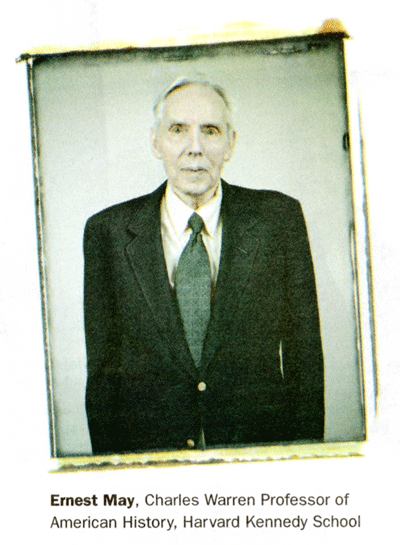
>bump< - just added the photo of Ernest May...
sorry to anyone who may have trouble sleeping as a result...
Zelikow/May Also F***ed Up JFK Work
May 2000: Future Authors of 9/11 Report Produce John F. Kennedy Book Riddled with Errors
Historian Ernest May. [Source: Belfer Center]
An eminent historian finds serious flaws in a historical treatise about former President John F. Kennedy. The book, The Kennedy Tapes: Inside the White House During the Cuban Missile Crisis, was written in 1997 by conservative historians Ernest May and Philip D. Zelikow, and purports to be an unprecedentedly accurate representation of the events of 1962’s Cuban Missile Crisis based on transcriptions of recorded meetings, conferences, telephone conversations, and interviews with various participants. [Atlantic Monthly, 5/2000] Zelikow is a former member of George H. W. Bush’s National Security Council and a close adviser to future National Security Adviser Condoleezza Rice. [US Department of State, 8/5/2005] May is a Harvard professor. Both will participate heavily in the creation of the 2004 report by the 9/11 Commission. [Shenon, 2008, pp. 387-393] Almost three years after the Kennedy book’s publication, Sheldon M. Stern, the historian for the John F. Kennedy Library from 1977 through 1999, pores over it and the May/Zelikow transcripts. In the original edition, May and Zelikow admitted that their final product was not perfect: “The reader has here the best text we can produce, but it is certainly not perfect. We hope that some, perhaps many, will go to the original tapes. If they find an error or make out something we could not, we will enter the corrections in subsequent editions or printings of this volume.†But when Stern checks the book against the tapes, he finds hundreds of errors in the book, some quite significant. Stern concludes that the errors “significantly undermine [the book’s] reliability for historians, teachers, and general readers.†May and Zelikow have corrected a few of the errors in subsequent editions, but have not publicly acknowledged any errors. Stern concludes, “Readers deserve to know that even now The Kennedy Tapes cannot be relied on as an accurate historical document.†[Atlantic Monthly, 5/2000] One error has then-Attorney General Robert F. Kennedy talking about the planned “invasion†of Russian ships heading to Cuba, when the tapes actually show Kennedy discussing a far less confrontational “examination†of those vessels. May and Zelikow imply that the Kennedy administration was discussing just the kind of confrontation that it was actually trying to avoid. Another error has CIA Director John McCone referring to the need to call on former President Dwight D. Eisenhower as a “facilitator,†where McCone actually said “soldier.†May and Zelikow will be rather dismissive of Stern’s findings, saying that “none of these amendments are very important.†Stern will express shock over their response, and respond, “When the words are wrong, as they are repeatedly, the historical record is wrong.†[Shenon, 2008, pp. 42]
Product recommendation
And by the way...
that's another illustration of the evil behind public mythmaking substituting for history.